



In the heart of India’s capital, where power corridors, business districts, and historical monuments coexist, a quieter and more troubling story unfolds every day. It is the story of people who leave their homes and never return. Official statistics, police statements, and media headlines speak in numbers — thousands missing every year, many traced, some still unaccounted for. But behind these figures lies a pressing question: do these numbers reflect reality, or do they obscure a deeper and more complex crisis?
Over the last decade, Delhi has consistently ranked among the highest in India for reported missing persons. Yet, the way this data is presented and interpreted has sparked debate. Families of the missing, activists, and civil society organizations often argue that official reports tell only part of the story. They question whether the system’s emphasis on recovery rates and aggregate totals masks gaps in investigation, delays in reporting, and the lived experiences of those left behind.
The Official Narrative
Government data and police briefings paint a picture of efficiency and progress. Authorities frequently emphasize that a large percentage of missing persons are eventually traced. According to reports compiled by the National Crime Records Bureau (NCRB), most cases in Delhi are resolved within weeks or months, particularly those involving adults who leave home voluntarily.
From this perspective, the city’s high numbers are not necessarily a sign of increased crime but of better reporting mechanisms. As awareness grows and families become more willing to approach the police, more cases are recorded. Officials argue that this transparency is a positive development, not a failure.
However, critics contend that this narrative oversimplifies the issue. They point out that recovery statistics often do not reveal the conditions under which people are found, nor do they address the significant number of cases that remain unresolved year after year.
What the Numbers Don’t Show
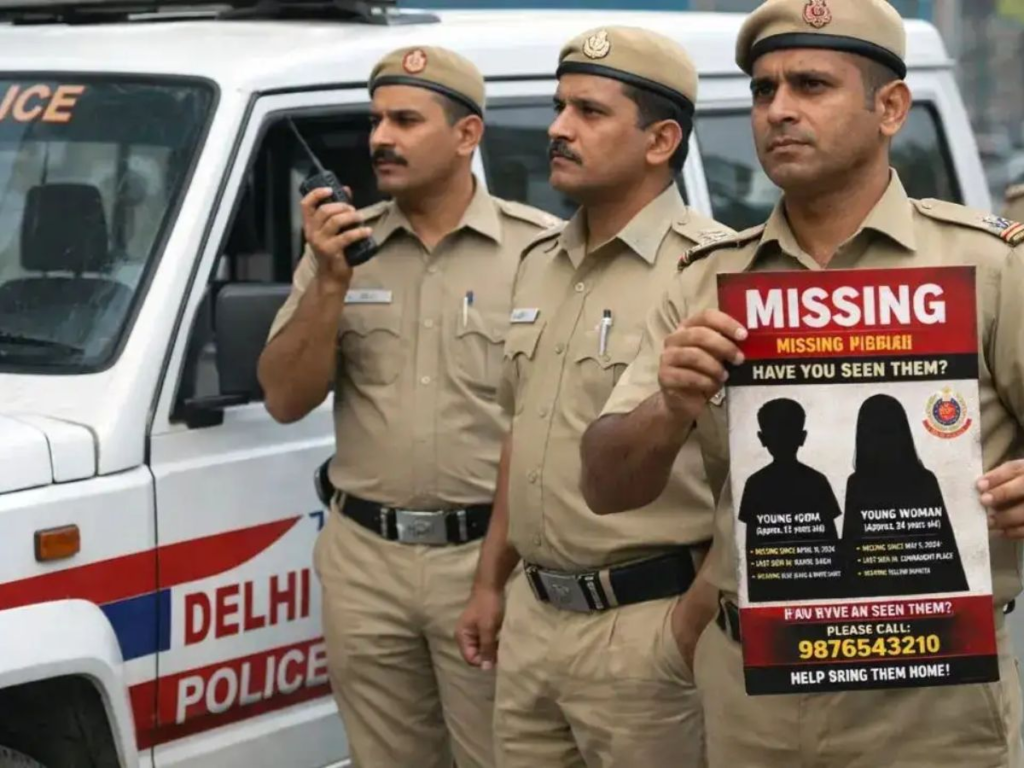
A closer look at missing persons data reveals patterns that raise uncomfortable questions. Women and children consistently make up a large share of reported cases. In several recent years, women and girls accounted for more than half of those reported missing. Teenagers, particularly adolescent girls, appear prominently in police records.
These figures challenge the idea that most cases involve adults leaving home by choice. Activists working on child welfare and women’s rights argue that many of these disappearances are linked to forced marriages, domestic violence, trafficking, and exploitation.
“The data may say ‘traced,’ but traced to what?” asks a social worker who has spent years assisting families of missing girls. “Some are found in abusive workplaces, some in exploitative relationships. Recovery doesn’t always mean rescue or justice.”
This distinction — between being located and being truly safe — rarely appears in official summaries.
The Human Cost Behind the Statistics
For families, the crisis is not measured in percentages or recovery rates. It is measured in days of waiting, years of searching, and the emotional toll of uncertainty. Many families describe a repetitive cycle of visiting police stations, hospitals, shelters, and railway platforms, carrying photographs and documents in the hope that someone might recognize a face.
In lower-income neighborhoods, the financial burden can be devastating. Parents may lose wages as they travel across the city to follow leads. Some sell possessions to fund private searches or legal assistance. When the missing person is the primary earner, the family’s struggle deepens, pushing them further into poverty.
There is also a social cost. Families of missing women often face stigma, suspicion, or blame from their communities. This can lead to isolation and discourage them from speaking openly about their situation, reducing the chances of finding help.
Migration and the City’s Invisible Population
Delhi’s role as a magnet for migrants adds another layer to the crisis. Every year, thousands arrive from rural areas and smaller towns, drawn by the promise of work and opportunity. Many settle in informal housing, take up temporary jobs, and live without formal identification or stable addresses.
When someone from this invisible population goes missing, tracing them becomes exceptionally difficult. Families in distant villages may not know where to file a report or whom to contact. In some cases, missing persons are never officially recorded because their families lack the resources or knowledge to navigate the legal system.
Urban anonymity works both ways. While it allows people to start anew, it also creates conditions where individuals can vanish without a trace, making the city fertile ground for criminal networks involved in trafficking and forced labor.
Trafficking and Exploitation: A Hidden Dimension
Law enforcement agencies acknowledge that Delhi is a key transit point in national and regional trafficking routes. Victims may be moved across state borders, making jurisdictional coordination a major challenge. Non-governmental organizations working on the ground report that many rescued individuals were originally listed as missing in police records, sometimes years earlier.
Despite this, trafficking-related disappearances are rarely highlighted in public data presentations. Critics argue that lumping these cases into broad “missing persons” categories dilutes the urgency of addressing organized crime and systemic exploitation.
“Calling it a missing case makes it sound temporary,” says an activist from a child protection group. “But trafficking is a crime with long-term consequences. It needs a different level of investigation and accountability.”
The Question of Data Transparency
One of the central criticisms of the current system is the lack of detailed, publicly accessible data. While annual reports provide aggregate numbers, they often lack breakdowns that could help researchers, journalists, and policymakers understand the root causes.
For example, how many cases involve minors? How many are linked to migration? How many result in legal action against traffickers or abusers? Without such information, it becomes difficult to design targeted interventions or measure the effectiveness of existing policies.
Transparency advocates argue that more open data would empower civil society to play a stronger role in prevention and support. It could also build public trust, reducing suspicions that inconvenient truths are being hidden behind statistics.
Law Enforcement Under Pressure
Police officials point to the scale of the challenge. With tens of thousands of cases reported annually, investigators must prioritize based on available resources. Cases involving children and suspected crimes are often fast-tracked, but even then, manpower shortages and administrative hurdles can slow progress.
Interstate coordination remains a persistent problem. Missing persons are frequently found in other parts of the country, requiring cooperation between different police forces with varying levels of capacity and technology.
To their credit, authorities have introduced online portals, helplines, and digital databases to improve case tracking. Facial recognition tools and mobile data analysis have also helped solve some high-profile cases. However, technology is not a substitute for ground-level investigation and community engagement.
Media’s Role: Spotlight or Sensationalism?
The media plays a dual role in shaping public perception. On one hand, investigative reports and human-interest stories have brought national attention to the plight of missing persons and their families. On the other, critics accuse some outlets of focusing on dramatic headlines without following up on long-term outcomes.
Short news cycles often mean that cases disappear from public view as quickly as they appear. Families may receive a burst of attention when they first report a disappearance, only to be left alone once the story loses its novelty.
Responsible journalism, activists argue, should focus not just on numbers but on systemic issues — the gaps in policy, the challenges faced by law enforcement, and the lived realities of affected communities.
Reality vs. Narrative
So, are the official numbers reality or propaganda? The answer may lie somewhere in between. The data itself is not necessarily false, but the way it is framed can shape public understanding.
Emphasizing high recovery rates can create an impression that the system is working smoothly, even when thousands of families continue to search for loved ones. Conversely, focusing solely on large totals without context can fuel fear and mistrust.
What is missing from both narratives is a nuanced discussion about quality, not just quantity — the quality of investigations, the quality of support for families, and the quality of outcomes for those who are found.
Civil Society and Community Action
Non-governmental organizations, legal aid groups, and volunteer networks have stepped in to fill gaps left by official systems. They run helplines, shelters, and awareness campaigns, often working closely with the police to locate missing individuals and support survivors.
Community participation has also proven crucial. Local residents, transport workers, and market associations have helped identify missing persons by sharing information and reporting suspicious activities. These grassroots efforts highlight the importance of collective responsibility in addressing the crisis.
The Way Forward
Experts agree that solving Delhi’s missing persons crisis requires more than improved reporting and better technology. It demands a comprehensive approach that addresses the social and economic conditions that make people vulnerable in the first place.
This includes strengthening education and employment opportunities in rural areas to reduce distress migration, expanding social welfare programs for urban poor communities, and ensuring that children and women have access to safe spaces and support services.
On the institutional side, greater investment in specialized police units, faster interstate coordination, and more transparent data systems could significantly improve outcomes.
Conclusion
Behind every data point is a human story — a parent waiting by the phone, a sibling searching through crowded streets, a child trying to survive in an unfamiliar world. The debate over reality versus propaganda should not distract from the fundamental truth that thousands of lives are affected by this crisis every year.
Delhi’s missing persons numbers are more than statistics. They are a mirror reflecting the city’s inequalities, vulnerabilities, and responsibilities. Whether the future narrative becomes one of accountability and reform, or of continued uncertainty, will depend on the choices made by policymakers, law enforcement, media, and society as a whole.
For families still searching, the question is not whether the numbers are accurate. It is whether the system will ever bring them the answers they desperately seek.